Power Source: Dual 18650 Battery Shield
For deployments in remote locations without external power, the IoT Toolkit uses a Dual 18650 Lithium Battery Shield. This module provides stable 3.3V and 5V power rails directly from rechargeable lithium cells.
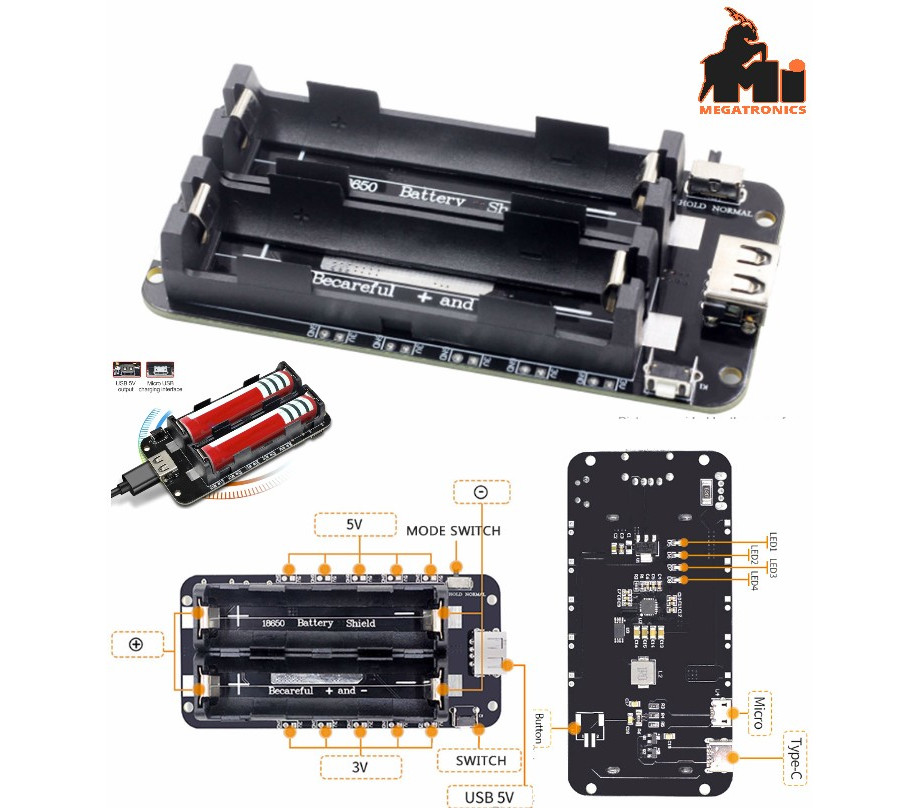
[!CAUTION] Polarity Warning: These modules rarely have reverse polarity protection. Inserting a battery backward will permanently damage the shield and potentially cause a fire hazard. Always match the + and - markings on the PCB with your batteries.
Specifications
| Parameter | Value |
|---|---|
| Battery Type | 18650 Li-ion (3.7V nominal) |
| Output Voltages | 5V (USB-A & Pins) and 3.3V (Pins) |
| 5V Current | Up to 2.2A (3A peak) |
| 3.3V Current | Up to 1A |
| Charging Port | Micro-USB / USB-C (5V Input) |
| Protection | Over-charge, Over-discharge, Over-current |
Key Features
- Integrated Charging: Charge your 18650 cells directly through the onboard USB port without removing them.
- Dual Outputs: Simultaneously power the ESP32 (via 5V or 3.3V) and external peripherals like high-power sensors or 5V displays.
- Status LEDs: Onboard indicators show battery charge level and charging status.
- Power Switch: Includes a physical toggle switch to turn the entire system on or off without disconnecting wires.
Wiring to ESP32
To power your ESP32 from the shield:
- Connect the 5V pin of the shield to the VIN pin of the ESP32.
- Connect the GND pin of the shield to the GND pin of the ESP32.
- Alternatively, you can use a USB cable from the shield's USB-A port to the ESP32's USB port.
[!TIP] Use high-quality 18650 cells (e.g., Panasonic, Samsung, LG) to ensure maximum runtime and safety during long-term field deployment.
Next Steps
- Proceed to Hardware Assembly
- Configure Power Management Strategies